Showing posts with label Sound Attic. Show all posts

Wednesday, February 10, 2016

Jamali Bai the mesmerizing folk singer from Bikaner city


Got an opportunity to attend one of the first concerts at the pump house in winters of 1998.

a truly memorable concert attended by popular working class people from that corner of the Bikaner city. There were watchmen, pump operators, gatekeepers, construction workers, hawkers, tea stall owners and vagrants of no profession all gathered in the star lit night. The performance was arranged on the top of the water tank of the pumping station. They had all gathered to listen to Jamali Bai and her husband Rahman ji

The regal elan of this subaltern culture is un paralleled in the recent history of the Bikaner city.


Click to Listen


Credits: All credits for the video clip to Shabnam ji and her colleagues at Kabir Project. 

Tuesday, February 9, 2016

Lilting Calls of the Been, Pastoral Music of North West Thar


Been Dhol  Ensemble at a marriage, Pugal, Bikaner


Been is an instrument that is rarely played for it is difficult to get deft players of this. The accompanying instrument dhol has is more popular in solo performances 
Nazare Khan ji testing his bagpipe, Pugal Bikaner


Nazre Khan Mir, old  ustad of the been testing out the instrument in his room in the presence of some elders and listeners 

Listen  

Sufiyana Qalam of pastoral north west Thar


Jani Rat Rahepo gali karse se

stay over in the night and we would talk
listen to each other and tell tales of times

Ustad Basaye Khan ji, Pugal Bikaner, March 2005

Ustad Basaye Khan, a veteran Mir musician from Pugal Bikaner rendered this song in an immortal way    

the traditional context of listening and performing very often used to be the nomadic encampment or the solitary semi permanent dwellings. It was an extremely popular song for especially elders having collected from distant villages during marriages and staying overnight at one place.

Listen

Thursday, October 29, 2015

Thar Parkar, Pakistan and Marwar, Rajasthan, India: the folk music connection

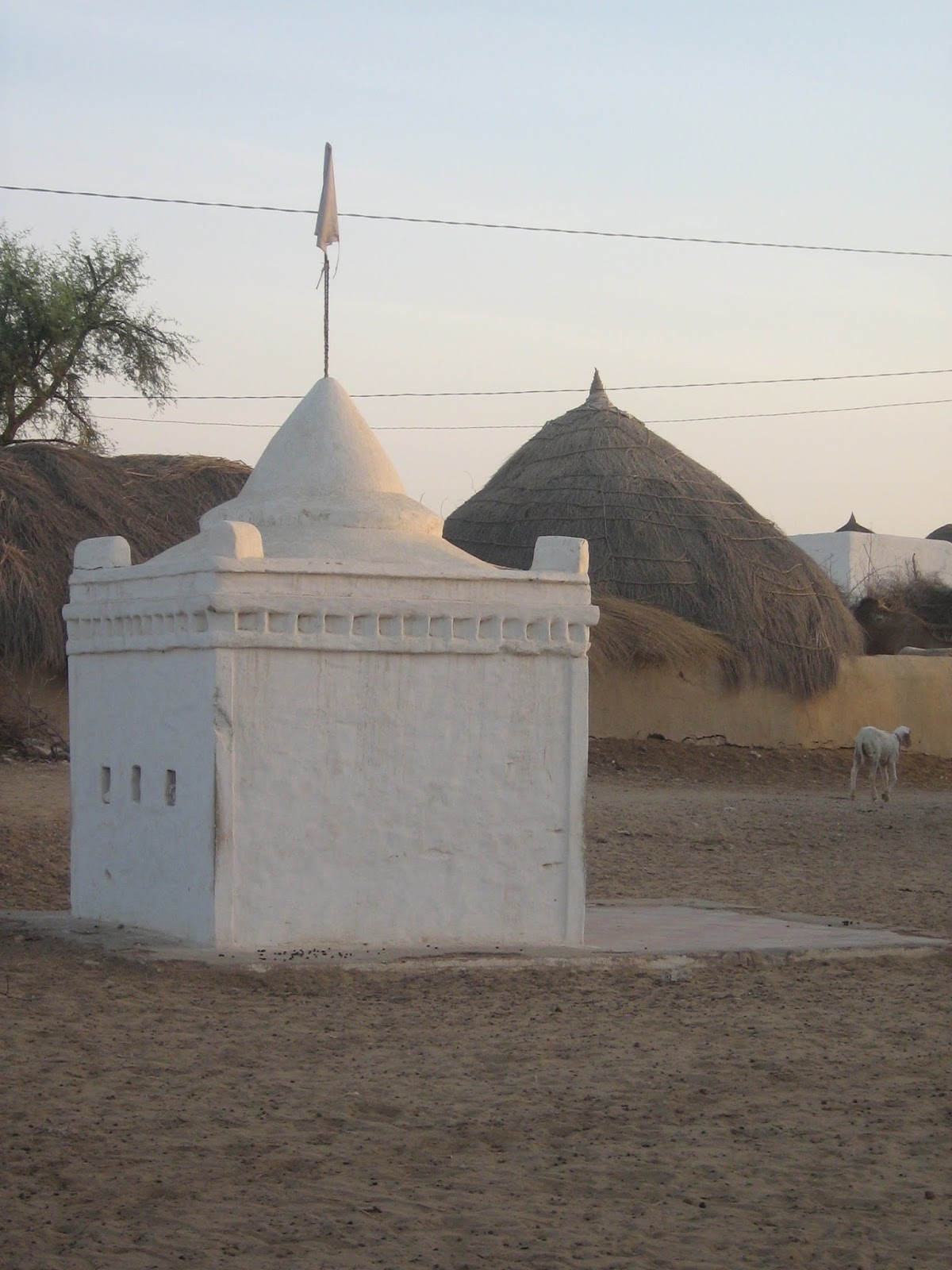
Than of Pir Pithora at Adoori, Bikaner 
Largely because of it's location, the Thar Parkar district has held an important place in the social and economic history of the arid regions of Rajasthan and Gujarat. The history of settlement of this region has made it a linguistic zone where several dialects like Marwari, Kutchi, Dhati, Sindhi, Balochi, Pathani, and Punjabi were spoken. This polyglot character of the region coupled with attributes of a frontier region has imparted the region with a cultural diversity that has got disseminated to the adjoining regions over successive historical periods.      

The contribution of the region in the formation of the folk culture of Marwar has been immense. Most of the popular folk songs which are hummed and sung by the people of western Rajasthan like todadlo, heli, moomal‑ mahendro, kachbo, balochan, raiko, jalal, hanjlo, ratan rano, ridmal, sodo khiwro have the Dhat region as their landscape. The famous historical couplet of ‘nav koti marwar’ mentions Omerkot, the farthest fort on the eastern banks of Indus, as one of the nine forts that mark the boundary of Marwar region.  This region has served as a refuge zone and a transitional region where the Rajputs of Rajpootana interacted with muslims from Sind and Balochistan.    

A Pak Ousteee in Command Area of IGNP Allotted to them
Around nine thousand families from Chachro taluka crossed over to villages of Chohtan and Sheo tehsils of Barmer in Rajasthan. About five thousand families from Nagar parkar taluka escaped to the neighboring region of Kutch and North Gujarat. These communities had fled for the fear of persecution, hardship and discrimination at the hands of the military dictatorship of the Islamic state of Pakistan as well as the uncertainties and grain scarcity of the war affected occupied territory. They defied the orders of the Shimla Pact of 1972 that stipulated repatriation of prisoners of war and civilian internees. The persuasions of the Sindhi politicians to take them back to Pakistan proved abortive. Their hopes for a better future in India eroded in the face of the growing hostility of the raiyas (natives) on the Indian side of the border as well as by the partisan treatment meted out by the Indian state. Viewed with suspicion they were doomed to exist as sharanarthis (refugees) dependent upon the rations provided by the Indian state in relief camps under confinement and strict surveillance. Theses refugee camps continued for a little more than a decade and have left indelible marks on the future life patterns of these communities. After the granting of Indian Citizenship in 1977 the refugee camps were gradually closed and by 1980 majority of these families were rehabilitated. In Gujarat around five thousand families have been rehabilitated in villages and towns of Kutch and north Gujarat. Some of the families have been given agricultural lands, others plots for setting up small business and household livelihoods and many were hardly given any assistance. In Rajasthan out of eight thousand families to be rehabilitated around five thousand were allotted rain fed agricultural land in Barmer and Jaisalmer district. And three thousand families were allotted twenty five bighas land in what would qualify as one of the worst patches of land in the canal command area of the IGNP Stage II in Bikaner in Rajasthan.

It is during extended sessions of listening to refugee lore from many men and women from different castes that the rich multi layered connections between these two regions gets revealed.

The multi-layered cultural exchange that had developed historically was further added on in years after the exodus. The gripping popular music of singers like Mai Bhagi, Haider Rind, Fojia Soomro, Kasam Aadoo, Sawan Khan, especially it's nostalgic and emotional rendering, make listening of experiences of this community a memorable event. The recordings of live music sessions of these singers, while invoking the memory of displacement and life in Thar Parkar reinforces the strong cultural traditions of the Dhati community which gave them strength to cope up with tough times in an uprooted context of survival.  One such cultural strategy has been the recreation of shrine of Pir Pithora, a popular deity in Thar Parkar, in their new villages.   

Bhagi ji and Jivraj singh soda (vani session at Adoori, Bikaner, April 2010) 
These regions have had their own share of rich music traditions by Meghwals and Ravanna Rajputs who using simple instruments- a tanpoora, mata and khanjari- create reverberating music that serves as a bridge not only between the different scattered communities but also provides soulful connections for remembrance of past.


Wednesday, October 28, 2015

Kalbelias of Thar, Rajasthan

Jagdish Nath and Party, Lunkaranasar, Bikaner, December 2000
Rajasthan is known for its tourism and that too with a mystique. Among these tourist circuits, heritage hotels, shanty guest houses, makeshift taverns and camps on sand dunes, it is quite common to encounter women dressed in black dress, adorned with imitation silver ornaments being paraded as kalbelia dancers.   Who are kalbelias? What are the heroic trajectories of this community who gets so cheaply represented as  ‘dancers’ whose deft and athletic  movements conjures up the heady feeling of so called ‘rangilo rajasthan….

It would be quite appropriate, to start with, clarify certain basic propositions regarding what constitutes an ‘alternative representation’ of a nomadic and marginal community of Kalbelias. It is an alternative to the veiled, static and stereotypical and ahistorical representations which are usually the subjects of much of ethnography that is so conveniently paraded by tourism for it profits. In particular we have in mind a representation that is able to articulate a perception that takes into account the temporal dimension and incorporates the historical growth (with all it’s regressions, transitions, and expansions) of a community. Such a representation facilitates understanding in a manner that the ‘present’ of a community is then explicable in a concrete historical context, and not simply a metaphoric and hyperbolic context constituted out of ‘essentials’. A representation like that then is rendered more capable to articulate the perceptions and sensibilities of the members of community, the anxieties, hopes and aspirations of the community better.

Let me clarify what this means in the context of Daliwal Kalbelias. The Daliwal Kalbelias are even today mostly looked at as ‘snake charmers’ only. This representation is so powerful and all pervasive that it contributes to obfuscate and stunt any other way of looking at them. It completely hides the fact that men amongst them are good musicians, women good embroiderers and on a whole are a community caught in a blind fatalistic destiny, existing on the fringes of society caught in an uncertain dilemma about settling / pulling on with a nomadic existence.

Good poongi (A kind of an aerophonic instrument, two tubes (pedis) fixed to a hollow gourd – one for the notes and the other for the drone) players feel disgusted and let down by the fact of their playing of that instrument being only associated with catching and showing snakes. They feel that the artistry involved in playing music has not been given it’s due and is, in fact, been treated as subsidiary to showing snakes. And such reactions are so common and pervasive that they constitute a whole perspective and a position on the Kalbelias being regarded essentially as ‘snake charmers’.

So rather than understanding ‘nomads’ as static anachronistic elements, to be left to their own imminent death, an effort is made to constitute a process that is more closely and passionately able to present and argue their case. It is acknowledged too often that Rajasthan, especially the western parts of it, “…has a large number of nomadic communities”.

But the implications of this rarely seem to inform the prevalent notions and practices surrounding the processes of development. The ethnographic humanscape that consciously or unconsciously exists in the contemporary discourses on development is a sedentary one that constantly succeeds in relegating the deliberations about the nomadic communities to the margins. By a sedentary ethnographic humanscape what is meant here is the basic social grid that is the point of reference of the majority of development schemes and programmes, governmental or otherwise. The nomads are conspicuously absent from this. Similarly sedentary perspectives pervade most of the thinking about the element of mobility that is one of the constitutive rhythms of a major portion of everyday life at least in the western parts of the state of Rajasthan. Sedentary perspectives tend to understand the ‘element of mobility’ from their own ‘fixed’ standpoints. Most of them understand it as an aberration rather than as an organic element of everyday life of many communities. All this amounts to marginal considerations accorded to the ‘future’ of nomadic peoples. An ‘alternative representation’ has ‘stakes’ in the dissipation of such views.      


Nomadism of the Daliwal Kalbelias: An Explanation

We are talking here about a group of Daliwal Kalbelias who live in makeshift nomadic settlements in and around villages and towns of North West Rajasthan. The Daliwal kalbelias are a section of the Kalbelia community and are also known as Sapera or Poongiwala or Jogira. It must be pointed out that among the Daliwal Kalbelias the notion of the ‘community’ is very fundamental and the nomadic elements have to be made sense in that context.

The Daliwal Kalbelias are divided into a number of exogamous clans or gotras. Community endogamy is strictly followed but now sometimes they also practice marriage within the same clan. But they always avoid four generations in the ascending order. Apart from these well structured rules of inter-community interactions there are many features that speak of an inherent egalitarianism, philosophical and mystical binding that keep the ‘community’ together. This finds it’s own expression in their nomadic existence. If we go by the prevalent ethnographic understanding then along with Gadia Lohars, etc the Kalbelias are among those communities that are still strongly nomadic having refused to or unable to settle down. Nomadism is something that is deeply permeated in their everyday life and structures their interactions with the settled communities.  But what are the temporal dynamics of this mobility!     

We know that as a rule, persecutions were widespread in the Ancient World. Part of it was the result of the process of acculturation, the frictions it generated, and the major part of it was the consequences of long drawn out animosities, both metaphysical in nature and social. All this made migrations and mobility, flights and maneuvers, movement of groups and sects a regular feature. This aspect of mobility is intrinsically linked to historical change.

The glimmerings of such a dynamic phase can be seen from the beginnings of the 11th  century that was going to culminate in the second urban revolution. At the level of substrata, where human beings mattered, we see the comings and goings of heretic sects from Central Asia and Iran along with their mystics and seers. Delhi became a haven and refuge for persecuted philosophers, sciences, heretics during the ‘mystical prince’, Iltutmish’s reign. Selective and discriminatory privileges co-existed with a policy of internal repression, and nowhere was this felt more intensely than in Delhi. Following this period there were forced migrations and flights away from Delhi in search of other havens and pastures. It was from this context too that the Daliwal Kalbelias moved away from Delhi, though not en masse, to more nomadic, ascetic and renouncing life styles, carrying with them the prefix Daliwal, meaning inhabitants of Delhi.       

During this expansionary phase of mobility, the kalbelias constitute themselves as a group under the spell, teachings and influence of the famous 13th century ascetic yogi, Baba Gorakhnath. Giving primacy to the body under the precepts of Patanjali’s Yogasutras, Baba Gorakhnath came to be regarded as a legendary messiah in the Persian chronicle Dabistan-al-mazhab as well as an extraordinary avatar in the Chisti traditions of Punjab whose foremost figure was Shaikh Farid-al-Din, the mystic extraordinaire. Under Baba Gorakhnath many yogic / nath schools and tendencies flourished and  Kalbelias were one of them.


Tuesday, October 13, 2015

Ustad Nusrat Ali Fateh Ali Khan Sahib: the blessed voice radiating wilayat of sufis


On the occasion of the great mastero's 67th birthday it would be only appropriate to listen to his magical soul stirring voice as much as y can.

he would be undoubtedly remembered as a wali of music who extended the wilayat of sufis in the world, a true trailblazer who gave us the grace and abundant occasions for music of pure love.... unplugged, unadulterated

For us associated with the Thar, Rajasthan, he has been a harbinger of melodies pure and simple. Resonating in the vast desert, of formidable sand dunes and vast sandy plains, his six octave sonorous and prophetic prescient voice guides us to continue.......  

His grace illumines our daily lives.

Our deepest gratitude and prayers for his soul to rest in peace forever

enjoy these qawwalis


kitte ishq da rog na la https://www.youtube.com/watch?v=6j5eMMY7lqk   

Sanu ek pal chain ne aave https://www.youtube.com/watch?v=Ge6tWkhohiQ
mele ne wichar jaana https://www.youtube.com/watch?v=pwg8pqsGUQA

Tuesday, August 27, 2013

Raga Megh in Thar desert, Pugal, Rajasthan


The grand old Ustad Ghulam Mohammad from Pugal who learned Hindustani classical music in Bahawulpur for eight years. During this period of stay in Bahawulpur he had the privilege of giving performances in Chachar Sharif in Kot Mithan at Khwaja Ghulam Farid's sacred tomb.

Inspite of his age Ustadjee is an atttentive person with a sharp  rather acrid sense of wit. He is the Mir Manga (Genealogist) of the Mirs of Pugal.  


He still savours the rich aromatic and spicy pugal style ghost (mutton) soaking wet in thick gravy of mustard oil turned red with chillies and sprinkled with copious amounts of fried garlic.


Click to hear Ustad Ghulam Mohammad

Saturday, August 23, 2008

Ghulam Mohammad Mir narrates....


Ghulam Mohammad Mir is from Pugal in Bikaner, who has learnt classical music as well for eight years in Bahawalpur, proudly says


“…this is the area of Sufiyayna qalam...this region has been blessed by one of the mort important Sufis, Khwaja Ghulam Farid who has spent considerable time of his life here and composed in the praise of the desert…our singing is different from the Sindh region…it has similarities with the Patiala and Sham Chaurasi Gharana of Punjab, exponents of which have sung immortal sufi qalam. In our tradition the most common ragas are Bhimpalasi, Malkauns and Multani Kafi…”


Expounding further on the tradition the regal old man tells that Ishq (love) was the first thing to be made by Allah when he created Muhammad. He then sang in his sonorous voice the ibtadayi baat (tale of the beginning) as is expressed in a qalam by Ali Haider. It talks of the primordial relationship between Ishq and gana (song) at a time when there was nothing else:


Jadon Ishq wali bang mele saiya puchan laga kaun imam ha

Na nau kalam na kurshi arash

na zamin te na asmana

na macca mojij te na ganga tirath

na kufr te na Islam ha

Ali Haider mian

Jadon Ishq de hath wich gana jad Ishq he Ishq da Imam ha"


"when I heard the call of love

the beloved asked: what sort of Imam are you!

I said: neither of the earth nor the sky

nor from miraculous places like macca or sacred pilgrimages like ganga

Neither the Kafir, nor the Islam

Ali haider, Oh dear when love sings

I am the Imam of love and love alone"


Hear Ghulam Mohammad recounting a tale