Showing posts with label Folk Musicians. Show all posts

Monday, December 4, 2017

Of enticing overtures and ecstatic renditions: folk musicians communities in Thar, Rajasthan


Ustad Hakam Khan ji, Barmer 
The desert districts of Rajasthan have been well known for their vibrant folk music traditions. Musicians from here were among the first to give scintillating performances in ensembles of national and international cultural festivals organised by the Indian nation state especially after the seventies. Contemporary community traditions popular among folk musicians from the deserts of western Rajasthan  recount with pride names of Allah Jilai Bai, Dodhe Khan, Sadiq Khan, Bhungar Khan, to name a few pioneering artists, around whose performances a distinct identity of ‘Rajasthani folk music’ grew in India and abroad. In the initial heydays of construction of ‘national culture’ by the young Indian state, these musicians from remote rustic interiors of Thar were much sought after ‘culture makers’ of scintillating performances.

Over the last few decades this quaint and rustic representation of ‘Rajasthani folk music’ has transmuted into a veritable trope of brand ‘Rajasthan’ being represented in different forms and patterns by public and private actors. Although only a handful of musicians from these communities are now regulars on national and international festivals, tours and cultural exchange circuits of different genres of ‘world music’, this has contributed to the much hyped visibility of folk musicians. Without doubt singers and musicians like Anwar Khan, Fakira Khan, Mukhtiyar Ali, to name a few prominent ones have really contributed in continuing to make sufi music known world over. In our contemporary times of short lived stardom and a crowding of the sufi genre by performers who are urbanites, these folk sufi performers they have managed to carve out dignified niches of existence.  In public gaze this has fed a misconception about these communities having good fortune in this culture industry that continues to expand and diversify around brand Rajasthan.

The production of culture industry incessantly expands its influence becoming widespread with many Indian and foreign labels fervently producing ‘haunting’, ‘seductive’, ‘melodic’, ‘lilting’, ‘soul stirring’ folk music from the deserts of Thar, Rajasthan.  This is not to mention Bollywood film music that has with uncanny consistency transmogrified this pristine music into mass entertainment. Latest to join the on- going glitter of this culture industry are mega live music events amidst sand dunes, recreating the royal heritage, organised in collusion by media syndicates, local tourism lobby and regional elites. The folk musicians are paraded endlessly to adorn the gatherings of culture elite, fairs and festivals in Rajasthan. Folk music interludes are a quintessential feature in tour and travel packages for foreign and domestic tourists. The enticing overtures and soul stirring renditions of these musicians are ceaselessly marketed globally and locally by music industry- tourism complex.

Underneath this scintillating and loud sonic extravaganza of folk music lies a sordid story of languishing traditions, pathos and destitution that characterises lives of majority of these marginal practitioners of culture. Engulfed by these existential dilemmas regarding dignified continuation of their music traditions, these musician communities find themselves at cross roads. With the waning away of traditional societal contexts of hereditary transmission of these traditions, the twin spectre of crass commercialization leading to dissipation of their musical traditions and dwindling opportunities for sustained livelihood looms large over them.
In the contemporary context where issues of everyday existence, dignified arts practice of these musician communities continue to escape public discourse with unceasing monotony are their strategies and processes possible that contribute to well- being of these musician communities?

Of enticing overtures and ecstatic renditions seeks to draw attention to issues of pathos and destitution that paradoxically engulf the lives of musician communities whose music is the harbinger of peace, serenity and soulful ecstasy.

These musician communities have been subjects of ethnography, tour diaries and memoirs. Ethnomusicologists have engaged with these musicians whose music has been subject of much study, documentation, archiving and survey for the last three decades, if not more. This ‘western quest’ of ethnomusicology originating from universities in UK or USA has contributed a systematic body of ethno-musicological literature / archive. The rich collection / archive of folklore and ethno musicological inquiries have engaged with some of these communities and their selective repertoire over the last few decades. While not discounting the value of the repertoire collected or insights regarding music in society it could be safely said that it has mostly refrained from engaging with challenges of lived everyday context of these makers of the music.

It has been correctly observed that the tourists and visitor are not very different from ethnomusicologists. They both share the fascination for the unique and spectacular elements. This is much to the neglect of the material context of these musicians. The emphasis has been on the music, as it is consumed, not on the musicians. Another emergent trend is the individual ‘creativity unplugged’, ‘soul searching’ kind of creative arts practice that subordinates folk community creativities as subservient to its own exalted aesthetic feats. The climax of this celebration of ‘creativity outside the folk sphere’ is most glaringly seen in Bollywood, the industry processing folk music into mass entertainment.

The irony implicit in these promises of job creation is that these do little to alter basic existential realities of these musicians, that of being integrated largely as casual wage earners at the bottom of the culture industry. With the expansion of techno aesthetics of culture industry networks especially in the last decade, both in density and spread, employment generation based on folk music thrives on casual payment contracts, many times unspecified and assuaged by neo feudal hegemony. In such a context there is little hope to be pinned on culture industry,  in its current dispensation, in liberating these folk musicians from drudgeries of daily survival in an ‘economy of tragic choices’.

Instead of getting mystified by a cultural aesthetic that seeks to assuage the sentimental narrative of bemoaning the loss of traditions or becoming bewitched by glittering gismo of unbridled commercialization making community folk aesthetic completely subservient to the whims of ephemeral modern entertainment, or even the individual quest of soul searching creativity of urban professional artists, it is important to invest in human resources and cultural skills of these unique producers of veritable civilizational intangible heritage.

Mir Abdul Jabbar and Mir Vassu Khan, Bikaner
One possible way is to strengthen the resilience and inventiveness of cultural traditions by taking account of skilful and refined "interweaving, combining and conjoining" that is the continuing hallmarks of these robust ‘traditions under siege’ in the modern world. Traditional cultural traditions need to be recognised as veritable skills having the potential of translating into viable livelihood strategies. The versatile ability displayed by many of these musicians to straddle effortlessly across different repertoires and indeed different performative contexts exemplifies innovation that springs from frugal resources. It is important that this be not recognized as individual ‘talent’ alone, rather seen as embedded in collective core of these traditions. It is this that needs to be nurtured.

Friday, September 16, 2016

Learning from ‘cultures’ of pastoralism for sustainable development in Thar


The Indian Thar is a hot desert and ranks among the few deserts of the world that have had a long and populous human history of settlement. This sustained human settlement has been made possible by unique attributes of the complex of eco systems and their natural endowments that make the natural setting of Thar. Equally ingenious and resilient have been life practices of different communities, mobile and sedentary, who have displayed remarkable forbearance and endurance in populating the region. Different varieties of pastoralism practiced by semi nomadic communities complemented with subsistence oriented rainfed farming have been core elements in constituting, settling and sustaining human history of this region.

The changes over the past few decades beckon us to understand experiences of modern transformation of pastoral Thar especially since the last quarter of the 20th century with the coming of IGNP in north-west Thar. Ideologically propped up by Jawaharlal Nehru as the 'kingpin' of State planning for developing the desert, the IGNP was started with generous loans from the World Bank and a favourable policy framework enabled by the Indus Water Treaty of 1960 between Indian and Pakistan under the watchful gaze of the World Bank. The main components are the 445 km long lined canal running parallel to the Indo-Pak  border, nine branches, seven lift schemes and twenty-one direct distributaries apart from 8187 km. of minor canal network. The state claims to have opened more than ten lakh hectares of area for irrigation and provide drinking water to more than 3500 towns and villages. IGNP is a gigantic settlement and irrigation project that is supposed to benefit more than 2 million people. So far so good!

Most of development strategies and precepts that have informed the making of ‘modern development’ in Thar region argue that pastoralism as a resource use system must / should / would be done away with, transformed into sedentary husbandry integrated with dairy industry and in a subsidiary position to the meta- narrative on agro industrial farming. It could be said that this development thinking is rooted in perspectives on maximizing private economic profit derived from irrigated farming as the prescribed dominant land use system. Surplus gained from this agricultural enterprise, it is argued, would then feed the diversification into non-farm enterprises and to the making of agro industrial complexes. The dominant assumptions of this economic thinking against pastoralism influenced formulation of apathetic development policy and tardy implementation of development schemes and programmes relating to livestock rearing.

It would not be inappropriate to reiterate that sustainable modern development does not mean economic transformation alone but is better and more fully understood as well- being incorporating dimensions of human and ecological well- being. In keeping with this perspective pastoral way of life is more suited, better rooted historically and ecologically among communities in north-west Thar as compared to  ‘modern development’ that is a recent undertaking primarily orchestrated by state, increasingly controlled by market,  imposed from above and benefitting only a few.

The culture of pastoralism as it developed and sustained itself over long periods of human history in Thar has been adaptive in sharing an interface with subsistence based agriculture and had evolved elaborate customary practices to use and regenerate collective natural endowments of water and fodder. The social organization of this pastoralism consisted of reciprocal ties among communities for utilization of scarce natural resources, adoption of rustic lifestyles that had ability to survive in the long periods of harshness and bloom in the brief spells of abundance. The sway of pastoral way is evident in the dexterous everyday work ethic of rearing animals to aesthetic pursuits of exquisite creations of music and rustic textiles and other crafts. The embedded pastoral landscapes of wide limitless horizons and sprawling sandy plains interspersed with grasslands form a backdrop to growth of musical traditions of sufiyana qalam that celebrate pluralism of human existence and are marked by a heightened ecological sensibility. These life-sustaining practices that illumined the material and symbolic world weave the complex of cultures of pastoralism. The unique contribution of this culture has been notions of abundance and well- being by perfecting frugal lifestyles in a resource scarce region.

This is not a romanticist reinstating. There is need to specifically engage with issues relating to complex ‘culture’ of pastoralism and ‘modern development’ to ask meaningful questions regarding integration and adaptation of the culture of pastoralism in the emerging geography of built environments, roads crisscrossing canal networks and agricultural fields. Far from assuming that contemporary pastoralism is in an inevitable crisis and should/would give way to agro industrial complexes in the rapid on-going transformation, the role of pastoralism needs to be understood keeping in view the historically evolved human ecology of the region and a realistic assessment of possibilities and limits of ‘modern development’ for a sustainable future of Thar. This is quite in order given the high environmental costs, increased economic disparity, intensification of private resource use that characterize the nature of transformations brought in these regions with ‘modern development’.  The sordid tale of grass root realities of colonisation of desert grasslands and water sources - the common property resources - has led to marginalisation of pastoralists and created a political economy of natural resource use that has set in conditions for greater pauperization of poor allotees, stifled collective initiative, intensified resource use and control by private property and greater penetration of market and tightened the hold of soulless institutions of the state.

These questionings are emboldened by several studies elsewhere in world that have highlighted the critical importance of pastoralism in its contribution to sustain natural economy that makes possible and acts as an environmental cushion for the fast urbanizing world. Extensive land use systems need to be promoted and regenerated with reference to arid and super arid regions like the one under discussion. In a world that is increasingly becoming intolerant,  plagued with xenophobic conflict, unbridled consumerism, heightened and often cut throat individualism, and social stress, the deep message inherent in this popular pastoral culture of sufiyana qalam is coterminous with wisdom, love, peace, and dignity of all life. 

There is sense in learning from this remarkably resilient and frugal way of life. It may hold insights and cues for transition to a sustainable world.


Read Related Stories:

http://rahulghai.blogspot.in/2015/12/ignp-canal-in-rajasthan-experiences-of.html

http://rahulghai.blogspot.in/2015/12/pastoralism-in-thar-ignp-and.html

Wednesday, February 10, 2016

Jamali Bai the mesmerizing folk singer from Bikaner city


Got an opportunity to attend one of the first concerts at the pump house in winters of 1998.

a truly memorable concert attended by popular working class people from that corner of the Bikaner city. There were watchmen, pump operators, gatekeepers, construction workers, hawkers, tea stall owners and vagrants of no profession all gathered in the star lit night. The performance was arranged on the top of the water tank of the pumping station. They had all gathered to listen to Jamali Bai and her husband Rahman ji

The regal elan of this subaltern culture is un paralleled in the recent history of the Bikaner city.


Click to Listen


Credits: All credits for the video clip to Shabnam ji and her colleagues at Kabir Project. 

Tuesday, February 9, 2016

Lilting Calls of the Been, Pastoral Music of North West Thar


Been Dhol  Ensemble at a marriage, Pugal, Bikaner


Been is an instrument that is rarely played for it is difficult to get deft players of this. The accompanying instrument dhol has is more popular in solo performances 
Nazare Khan ji testing his bagpipe, Pugal Bikaner


Nazre Khan Mir, old  ustad of the been testing out the instrument in his room in the presence of some elders and listeners 

Listen  

Sufiyana Qalam of pastoral north west Thar


Jani Rat Rahepo gali karse se

stay over in the night and we would talk
listen to each other and tell tales of times

Ustad Basaye Khan ji, Pugal Bikaner, March 2005

Ustad Basaye Khan, a veteran Mir musician from Pugal Bikaner rendered this song in an immortal way    

the traditional context of listening and performing very often used to be the nomadic encampment or the solitary semi permanent dwellings. It was an extremely popular song for especially elders having collected from distant villages during marriages and staying overnight at one place.

Listen

Thursday, October 29, 2015

Thar Parkar, Pakistan and Marwar, Rajasthan, India: the folk music connection

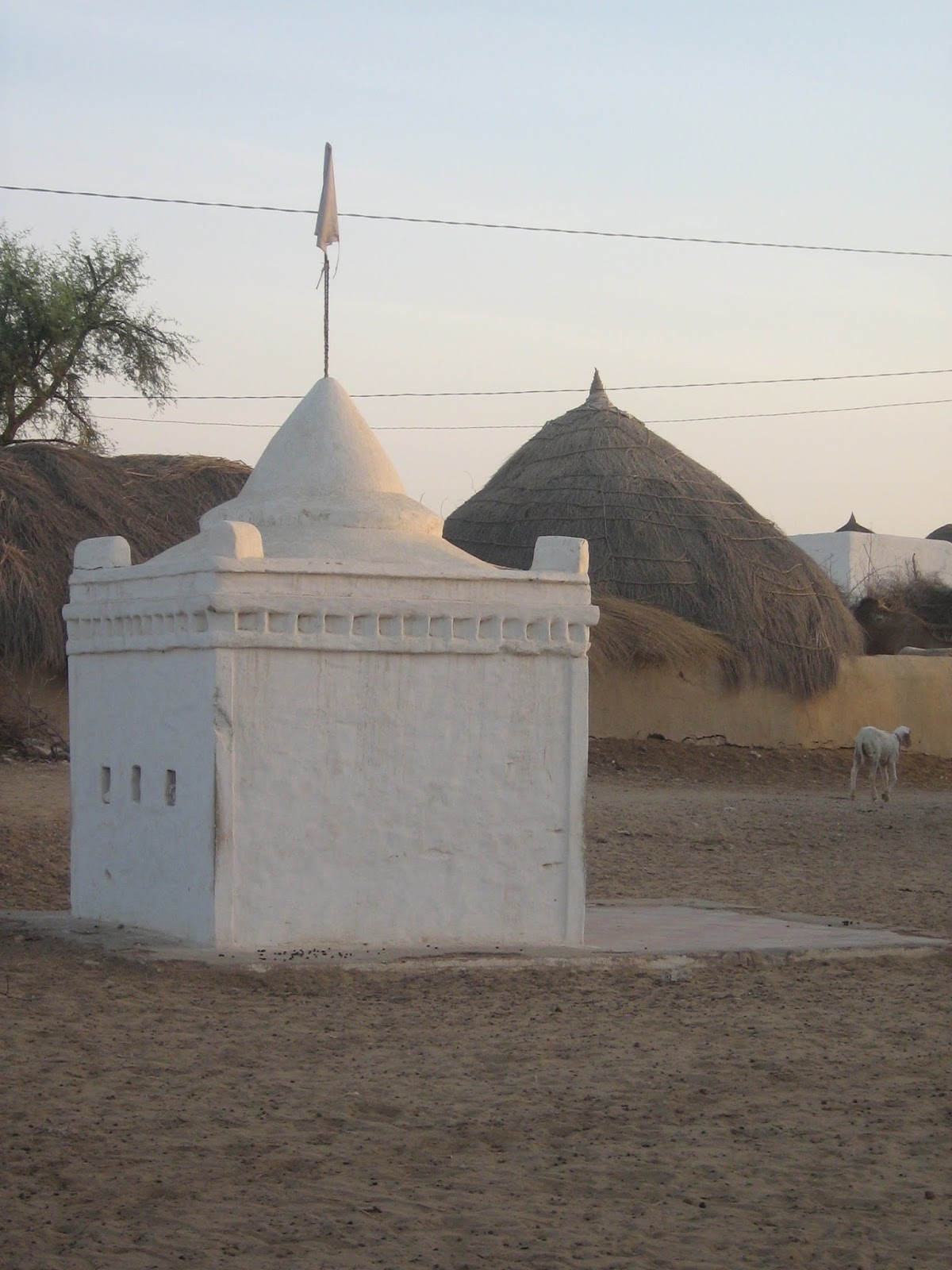
Than of Pir Pithora at Adoori, Bikaner 
Largely because of it's location, the Thar Parkar district has held an important place in the social and economic history of the arid regions of Rajasthan and Gujarat. The history of settlement of this region has made it a linguistic zone where several dialects like Marwari, Kutchi, Dhati, Sindhi, Balochi, Pathani, and Punjabi were spoken. This polyglot character of the region coupled with attributes of a frontier region has imparted the region with a cultural diversity that has got disseminated to the adjoining regions over successive historical periods.      

The contribution of the region in the formation of the folk culture of Marwar has been immense. Most of the popular folk songs which are hummed and sung by the people of western Rajasthan like todadlo, heli, moomal‑ mahendro, kachbo, balochan, raiko, jalal, hanjlo, ratan rano, ridmal, sodo khiwro have the Dhat region as their landscape. The famous historical couplet of ‘nav koti marwar’ mentions Omerkot, the farthest fort on the eastern banks of Indus, as one of the nine forts that mark the boundary of Marwar region.  This region has served as a refuge zone and a transitional region where the Rajputs of Rajpootana interacted with muslims from Sind and Balochistan.    

A Pak Ousteee in Command Area of IGNP Allotted to them
Around nine thousand families from Chachro taluka crossed over to villages of Chohtan and Sheo tehsils of Barmer in Rajasthan. About five thousand families from Nagar parkar taluka escaped to the neighboring region of Kutch and North Gujarat. These communities had fled for the fear of persecution, hardship and discrimination at the hands of the military dictatorship of the Islamic state of Pakistan as well as the uncertainties and grain scarcity of the war affected occupied territory. They defied the orders of the Shimla Pact of 1972 that stipulated repatriation of prisoners of war and civilian internees. The persuasions of the Sindhi politicians to take them back to Pakistan proved abortive. Their hopes for a better future in India eroded in the face of the growing hostility of the raiyas (natives) on the Indian side of the border as well as by the partisan treatment meted out by the Indian state. Viewed with suspicion they were doomed to exist as sharanarthis (refugees) dependent upon the rations provided by the Indian state in relief camps under confinement and strict surveillance. Theses refugee camps continued for a little more than a decade and have left indelible marks on the future life patterns of these communities. After the granting of Indian Citizenship in 1977 the refugee camps were gradually closed and by 1980 majority of these families were rehabilitated. In Gujarat around five thousand families have been rehabilitated in villages and towns of Kutch and north Gujarat. Some of the families have been given agricultural lands, others plots for setting up small business and household livelihoods and many were hardly given any assistance. In Rajasthan out of eight thousand families to be rehabilitated around five thousand were allotted rain fed agricultural land in Barmer and Jaisalmer district. And three thousand families were allotted twenty five bighas land in what would qualify as one of the worst patches of land in the canal command area of the IGNP Stage II in Bikaner in Rajasthan.

It is during extended sessions of listening to refugee lore from many men and women from different castes that the rich multi layered connections between these two regions gets revealed.

The multi-layered cultural exchange that had developed historically was further added on in years after the exodus. The gripping popular music of singers like Mai Bhagi, Haider Rind, Fojia Soomro, Kasam Aadoo, Sawan Khan, especially it's nostalgic and emotional rendering, make listening of experiences of this community a memorable event. The recordings of live music sessions of these singers, while invoking the memory of displacement and life in Thar Parkar reinforces the strong cultural traditions of the Dhati community which gave them strength to cope up with tough times in an uprooted context of survival.  One such cultural strategy has been the recreation of shrine of Pir Pithora, a popular deity in Thar Parkar, in their new villages.   

Bhagi ji and Jivraj singh soda (vani session at Adoori, Bikaner, April 2010) 
These regions have had their own share of rich music traditions by Meghwals and Ravanna Rajputs who using simple instruments- a tanpoora, mata and khanjari- create reverberating music that serves as a bridge not only between the different scattered communities but also provides soulful connections for remembrance of past.


Wednesday, October 28, 2015

Kalbelias of Thar, Rajasthan

Jagdish Nath and Party, Lunkaranasar, Bikaner, December 2000
Rajasthan is known for its tourism and that too with a mystique. Among these tourist circuits, heritage hotels, shanty guest houses, makeshift taverns and camps on sand dunes, it is quite common to encounter women dressed in black dress, adorned with imitation silver ornaments being paraded as kalbelia dancers.   Who are kalbelias? What are the heroic trajectories of this community who gets so cheaply represented as  ‘dancers’ whose deft and athletic  movements conjures up the heady feeling of so called ‘rangilo rajasthan….

It would be quite appropriate, to start with, clarify certain basic propositions regarding what constitutes an ‘alternative representation’ of a nomadic and marginal community of Kalbelias. It is an alternative to the veiled, static and stereotypical and ahistorical representations which are usually the subjects of much of ethnography that is so conveniently paraded by tourism for it profits. In particular we have in mind a representation that is able to articulate a perception that takes into account the temporal dimension and incorporates the historical growth (with all it’s regressions, transitions, and expansions) of a community. Such a representation facilitates understanding in a manner that the ‘present’ of a community is then explicable in a concrete historical context, and not simply a metaphoric and hyperbolic context constituted out of ‘essentials’. A representation like that then is rendered more capable to articulate the perceptions and sensibilities of the members of community, the anxieties, hopes and aspirations of the community better.

Let me clarify what this means in the context of Daliwal Kalbelias. The Daliwal Kalbelias are even today mostly looked at as ‘snake charmers’ only. This representation is so powerful and all pervasive that it contributes to obfuscate and stunt any other way of looking at them. It completely hides the fact that men amongst them are good musicians, women good embroiderers and on a whole are a community caught in a blind fatalistic destiny, existing on the fringes of society caught in an uncertain dilemma about settling / pulling on with a nomadic existence.

Good poongi (A kind of an aerophonic instrument, two tubes (pedis) fixed to a hollow gourd – one for the notes and the other for the drone) players feel disgusted and let down by the fact of their playing of that instrument being only associated with catching and showing snakes. They feel that the artistry involved in playing music has not been given it’s due and is, in fact, been treated as subsidiary to showing snakes. And such reactions are so common and pervasive that they constitute a whole perspective and a position on the Kalbelias being regarded essentially as ‘snake charmers’.

So rather than understanding ‘nomads’ as static anachronistic elements, to be left to their own imminent death, an effort is made to constitute a process that is more closely and passionately able to present and argue their case. It is acknowledged too often that Rajasthan, especially the western parts of it, “…has a large number of nomadic communities”.

But the implications of this rarely seem to inform the prevalent notions and practices surrounding the processes of development. The ethnographic humanscape that consciously or unconsciously exists in the contemporary discourses on development is a sedentary one that constantly succeeds in relegating the deliberations about the nomadic communities to the margins. By a sedentary ethnographic humanscape what is meant here is the basic social grid that is the point of reference of the majority of development schemes and programmes, governmental or otherwise. The nomads are conspicuously absent from this. Similarly sedentary perspectives pervade most of the thinking about the element of mobility that is one of the constitutive rhythms of a major portion of everyday life at least in the western parts of the state of Rajasthan. Sedentary perspectives tend to understand the ‘element of mobility’ from their own ‘fixed’ standpoints. Most of them understand it as an aberration rather than as an organic element of everyday life of many communities. All this amounts to marginal considerations accorded to the ‘future’ of nomadic peoples. An ‘alternative representation’ has ‘stakes’ in the dissipation of such views.      


Nomadism of the Daliwal Kalbelias: An Explanation

We are talking here about a group of Daliwal Kalbelias who live in makeshift nomadic settlements in and around villages and towns of North West Rajasthan. The Daliwal kalbelias are a section of the Kalbelia community and are also known as Sapera or Poongiwala or Jogira. It must be pointed out that among the Daliwal Kalbelias the notion of the ‘community’ is very fundamental and the nomadic elements have to be made sense in that context.

The Daliwal Kalbelias are divided into a number of exogamous clans or gotras. Community endogamy is strictly followed but now sometimes they also practice marriage within the same clan. But they always avoid four generations in the ascending order. Apart from these well structured rules of inter-community interactions there are many features that speak of an inherent egalitarianism, philosophical and mystical binding that keep the ‘community’ together. This finds it’s own expression in their nomadic existence. If we go by the prevalent ethnographic understanding then along with Gadia Lohars, etc the Kalbelias are among those communities that are still strongly nomadic having refused to or unable to settle down. Nomadism is something that is deeply permeated in their everyday life and structures their interactions with the settled communities.  But what are the temporal dynamics of this mobility!     

We know that as a rule, persecutions were widespread in the Ancient World. Part of it was the result of the process of acculturation, the frictions it generated, and the major part of it was the consequences of long drawn out animosities, both metaphysical in nature and social. All this made migrations and mobility, flights and maneuvers, movement of groups and sects a regular feature. This aspect of mobility is intrinsically linked to historical change.

The glimmerings of such a dynamic phase can be seen from the beginnings of the 11th  century that was going to culminate in the second urban revolution. At the level of substrata, where human beings mattered, we see the comings and goings of heretic sects from Central Asia and Iran along with their mystics and seers. Delhi became a haven and refuge for persecuted philosophers, sciences, heretics during the ‘mystical prince’, Iltutmish’s reign. Selective and discriminatory privileges co-existed with a policy of internal repression, and nowhere was this felt more intensely than in Delhi. Following this period there were forced migrations and flights away from Delhi in search of other havens and pastures. It was from this context too that the Daliwal Kalbelias moved away from Delhi, though not en masse, to more nomadic, ascetic and renouncing life styles, carrying with them the prefix Daliwal, meaning inhabitants of Delhi.       

During this expansionary phase of mobility, the kalbelias constitute themselves as a group under the spell, teachings and influence of the famous 13th century ascetic yogi, Baba Gorakhnath. Giving primacy to the body under the precepts of Patanjali’s Yogasutras, Baba Gorakhnath came to be regarded as a legendary messiah in the Persian chronicle Dabistan-al-mazhab as well as an extraordinary avatar in the Chisti traditions of Punjab whose foremost figure was Shaikh Farid-al-Din, the mystic extraordinaire. Under Baba Gorakhnath many yogic / nath schools and tendencies flourished and  Kalbelias were one of them.


Wednesday, October 21, 2015

Ustad Basaye Khan, Mir i Alam from Pugal: Illustrious father of Distinguished Mir Mukhtiyar Ali

He was the legendary singer I met initially when Mukhtiyar was deciding to following his real calling of pursuing mystical singing of which he has now become the master and is well known all around. Basaye Khanji was his dad and somebody who was well versed not only in the art of sufiyana singing but known for his expertise in the alchemy of indigenous healing traditions of Lukman fakir. Basaye ji epitomized the dexterous forbearance that was the hallmark of those who have braved this harsh sand strewn desert.  


Just going to his house in one of the hot afternoons of Pugal, would never forget the first meeting with him that left an indelible imprint on my memory. It changed the manner in which I was to experience the region where had been working for over a decade with farmers and pastoralists. The piercing insights this short musical meeting gave were to endure for years to come and his voice still echoes in my heart.

Such was Basaye Khan ji, committed, humble and tenacious. An organic community leader his aura helped us enormously during those initial years of trial and experimentation in our effort to reinvigorate  Sufiyana qalam of the Pugal region.  

(click on the link to hear)

stay overnight and we would talk

Tuesday, October 20, 2015

Sanjoy Ghose’s Bikaner and Magraj Jain’s Barmer: harbingers of modern human development for vulnerable and marginal in Thar, Rajasthan

The Indian Thar has the distinction of being one of the few deserts of the world that have had a long uninterrupted human history. This magnitude of time has blessed it with myriad layers of life experiences, pasts and memories. For this reason the ‘present’ of the Thar is so densely embedded that transformations that modernity brings are nuanced, impregnated with immense possibilities.  The region of Thar continues to be a prodigal mass of vast sandy plains and uninterrupted chains of sand dunes merging into limitless horizons. It is well known that the Thar has its own characteristic appeal, a mystique that has its own aura of rustic and majestic forbearance of life in this harsh terrain. Last few decades have been times of radical transformation of the region.

Amidst all this gust of changes and the equally swiftly changing scenario of civil society action it would not be inappropriate to briefly write about two personalities who have had a major impact on the manner in which one makes sense of and engages in social and economic development of vulnerable communities living in interiors of Thar, Rajasthan. Indeed Sanjoy Ghose and Magraj Jain were two personalities who have motivated and would continue to inspire many in the quest for human dignity and well being.

Both of them are better known as individuals who formed two of the largest civil society organisations in western Rajasthan. URMUL Trust starting in 1984 as a subsidiary of the URMUL (Uttari Rajasthan Milk Union Limited) dairy was transformed by Sanjoy Ghose in 1987 into a veritable organisation committed to achieving food fodder and water security and a dignified quality of life for the poor and marginal communities in Bikaner district. Magraj Jain was the guiding spirit behind forming SURE (Society to Uplift Rural Economy) in 1990 to work for a just social order and upliftment of rural economy in the interior regions of Barmer district.

In their characteristic ways both strived tenaciously to bring modern development within the reach of the vulnerable and marginal desert communities. And in doing this both of them led exemplary lives of service beyond the self motivating people around him in the lessons of compassion and empathy for vulnerable and marginalized.   

Sanjoy studied in Elphinstone College in Mumbai and then went on to do an MBA in Rural Management from IRMA, Anand and a strong altruistic desire of service beyond self that made him live in the harsh deserts of Bikaner. Magraj Ji was born in a remote village in the interiors of Barmer district and was a village school teacher and later a district coordinator of Nehru Yuvak Kendra in Barmer. Perhaps it was his frugal upbringing and rustic values of piety rooted in Jain samskaras that made him devote himself towards selfless social service.

Magraji had a working career of more than six decades in this region and was a son of the soil par excellence and was a trailblazer for voluntary action among local people. Sanjoy Ghose coming for an upper middle class urban background actively worked in Thar for two and a half decades and has been and would remain a role model for anyone coming to work with Tharis from outside.    


Both of them aspired for striking a delicate balance between the rustic yet resilient traditions of survival of desert communities and modern science and technology. This involved shedding or acquiring as the case may be a balance of tradition and modernity in their own lives. Magraj ji though born in a traditional context in an underdeveloped region had an unflinching faith in modern science and technology and strived for integrating it in his life as well for the benefit of the common humanity in the backward region of Barmer. Sanjoy born and groomed up in modern urban life toned down and consciously de urbanised himself to come at a comforting level with traditional lived context of life in Thar. 

With respect to traditions of Thar both these personalities had a faith in the ability of these traditions to respond to challenges thrown up by the transformations entailed by modernisation processes. This belief in the intrinsic ability of these traditions got manifested in the love for common mortals which they both had and displayed with vigour.